
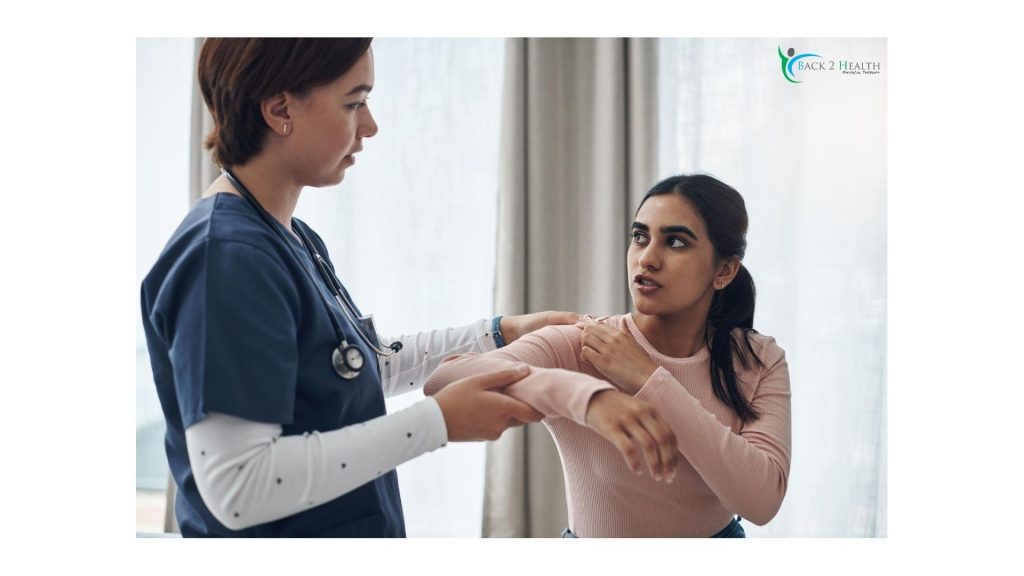
Full recovery is not just about shoulder surgery; it’s about what you do after the surgery has taken place. The proper shoulder surgery rehab, and customized physical therapy for shoulder pain all affect your healing. The entire journey involves tissue healing, biomechanics, muscle training, posture correction, and most importantly, a positive mindset. Let’s dive deeper to understand shoulder surgery rehabilitation.
Why shoulder surgery rehab?
When you go through a surgery, whether it is rotator cuff repair, labrum repair, dislocation, or any such surgery, the tissues in the body go through trauma. To address this, a structured healing process should be followed. It. Involves healing the inflammation, then curing the scar formation, and finally tissue remodeling.
Without guided rehabilitation, the following may happen:
- The shoulder can stiffen up
- Scar tissues can stop movement
- Normal muscle coordination breaks down
The biggest risk is unpredictable scar tissue formation.
Thus, effective shoulder surgery is very important. Proper shoulder surgery rehab includes:
- Understanding how the body heals
- Restoring long-term stability
- Retraining the shoulder muscles to move better
- Rebuilds confidence
- Preventing poor movement habits
A Modern Rehab Roadmap
Modern shoulder surgery rehab has become extremely advantageous. It is created to offer holistic healing to the patient. Here’s what it includes:
|
Phase |
Approx. Timeframe |
What it Includes |
What’s Important in this Phase |
|
Protection & Pain Management |
The first 2 weeks (sometimes up to 4–6 weeks depending on surgery) are all about this phase. | This phase involves sling immobilization, pain control, and avoiding stressing the repair. | Protection and pain management help prevent stiffness, avoid adhesions, and keep blood flowing while minimizing stress on the repair. |
|
Early Rehab/Mobility Restoration |
This phase goes for about 4–6 weeks or even 12 weeks. | It includes active-assisted range of motion (AAROM), gradually increasing ROM, but avoids heavy strain, resisted motions, and internal rotation/back extension. | This phase is best for capsular stabilization, posture correction, and gentle muscle activation. |
|
Strengthening Phase |
The phase goes from 8–12 weeks to 3–6 months. | This phase involves introducing light resistance exercises such as bands, light weights, isometrics, and gentle strengthening of the rotator cuff, deltoid, and scapular stabilizers. | In this phase, balanced strengthening is key. Also, build endurance gradually, rather than “go heavy fast.” |
|
Functional/Advanced Strength / Return-to-Activity |
This phase goes for 3–6 months and beyond (some protocols 6–12 months). | The phase involves working on full-range strength, coordination, overhead movement, and sport- or job-specific tasks. | In this step, there is integration of rehab principles into everyday posture and activities. |
Pitfalls That Should Not Be Ignored
The generic rehabs come with many disadvantages. These include:
- Ignoring the posture and scapular work can cause poor biomechanics.
- Immediately starting strength training or overhead tasks can overload the healing tissue.
- No long-term maintenance. This is the biggest red flag. Healing exercises should now be part of your lifestyle. Such as taking care of your posture at all times.
- Not taking care of mental health is another pitfall. As willpower is everything.
Back 2 Health: The Most Trusted Physical Therapy Clinic in Michigan
Recover safely with the Back 2 Health clinic!
Why Choose Back 2 Health Clinic?
Safe and Non-Surgical Approach
Our therapies offer a natural way of healing without relying on medications or surgery.
Personalized Treatment Plans
We offer a thorough assessment to create a customized therapy plan, which includes
- Hands-on techniques
- Targeted exercises
- Effective pain management strategies
Back 2 Health was established in 2016. It aims to offer a distinct physical therapy and wellness experience. Thousands of patients have been satisfied with the care provided at Back 2 Health Clinics. Hence, if you’re looking for a reliable, well-experienced physical therapy expert, then the Back 2 Health Clinic is here for you.
Wrapping Up
So, rehab isn’t just about finishing surgery. It’s also about going through proper physical therapy for shoulder pain. The skilled therapists at Back 2 Health offer personalized shoulder surgery rehab to help you fully.
FAQs
- When should physical therapy (PT) begin after shoulder surgery?
This totally depends on the kind of surgery the patient has gone through and the advice of the surgeon, because they have dived deep into operating on the patient. But, talking generally, people begin shoulder surgery rehab 1 or 2 days post-surgery. They start with passive motion exercises. For certain repairs or replacements, the procedure starts a bit late. Like after 2-5 weeks.
2. When can strengthening exercises begin?
After surgery, it is suggested to begin the strengthening exercises around 8 to 12 weeks. The initial strengthening uses light resistance such as bands, light weights, and more. This procedure gradually progresses.
3. How long does full recovery take?
Recovery depends on the patient’s tolerance power, body response, surgery type, and so much more. Thus, nothing specific could be said about recovery time. But, generally speaking, substantial recovery often takes 4 to 6 months.
4. After shoulder replacement (or complex surgeries), are there special restrictions?
Yes, after shoulder replacement or any such surgery, restrictions do arise. These include wearing a sling for like 6 weeks or so. Avoid active internal rotation and backward extension for around 12 weeks. The progression moves from passive motion, assisted motion, and light resistance to strengthening over several months.
5. Is long-term maintenance needed even after “full recovery”?
Yes, even after rehab with a skilled therapist ends, it’s essential for you to perform mobility drills, do strengthening exercises, and keep your posture right.
Tags: Physical therapy for shoulder pain, shoulder surgery rehab

